



It always starts with a feeling
It’s Thursday night and you’ve got a good feeling about the home side on Saturday.
So you do the responsible thing and look into it. Three wins from their last four. The away side has a midfielder out. Someone you follow on X likes them too, and his reasoning sounds solid.
By Friday lunchtime, that feeling has become a position. By Saturday morning, you’re wondering why the price is so big.
It feels like you’ve done your homework. Look closely at what happened, though. You didn’t find a single reason to stay away, and you weren’t really looking for one.
Your brain has a favourite team
Psychologists call this confirmation bias. Once we lean towards an idea, we go looking for evidence that fits it, and we give that evidence more credit than anything pointing the other way.
In 1960, the psychologist Peter Wason gave people three numbers, 2-4-6, and asked them to work out the rule behind the sequence. They could test any set of three numbers they liked.
Most people decided the rule was something like “goes up by two”. Then they tested 8-10-12 and 20-22-24, heard “yes” each time, and got more convinced.
The real rule was just “any three numbers going up”. They could have found that quickly by trying something that would break their theory, like 1-2-3. Very few thought to do it.
Now read your last pre-match research again. How much of it was 8-10-12?
More research can just mean more confidence
Here’s the study every bettor should know about.
In 1973, the psychologist Paul Slovic worked with eight experienced horse racing handicappers. They predicted races using 5 pieces of information, then 10, then 20, then 40.
On average, their accuracy barely moved between 5 pieces and 40.
Their confidence went up every time, for all eight of them.
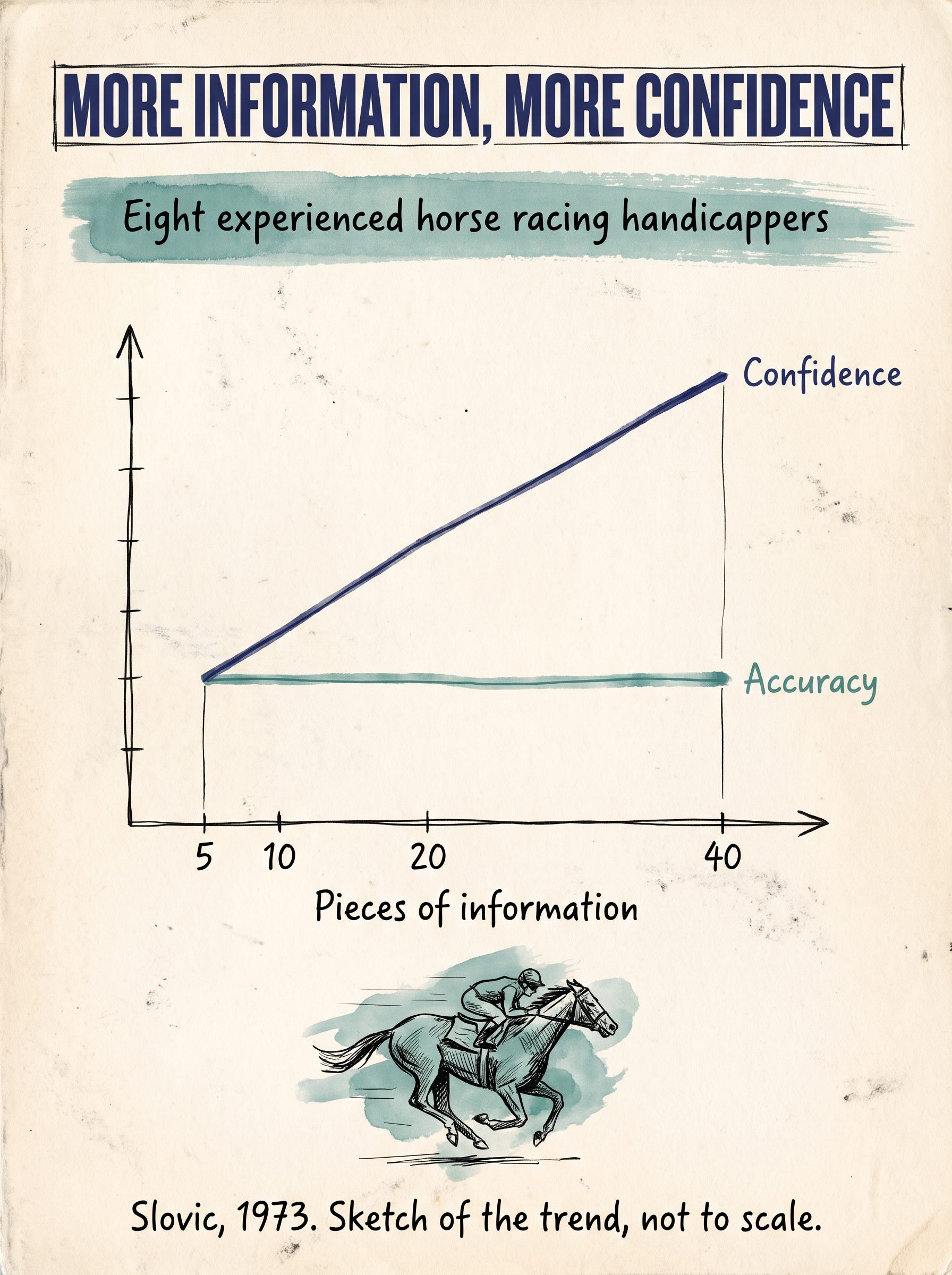
Those were people who handicapped horses seriously, and extra information still mostly made them feel better. If you’ve ever spent two hours on a match and come out certain, that should sting a little.
I’m still in favour of research. What matters is what it’s for. If you already know the answer you want, every stat you find just gets filed under “reasons I’m right”.
Where it costs you money
Confirmation bias rarely announces itself. It shows up in a few very ordinary places:
Stakes. A bet you’ve spent hours “confirming” feels stronger than it is, so it gets a bigger stake. That’s the confidence cliff again, and now it comes with footnotes.
Your feed. You follow people who think like you, so the group chat agrees with you and you count that as a second opinion.
Price. Once you’ve decided on a team, 2.10 and 1.85 both start to look fine. You’ve stopped asking what the price should be.
Your results. Wins prove you were right. Losses were a red card, a bad referee, a deflection. Either way you learn nothing, because you’ve kept the theory safe from the outcome.
That last one is the most expensive, because it stops you from improving. Plenty of bettors have spent years “unlucky” in the same market.
Argue with yourself on purpose
You can’t switch this off. Knowing about the bias doesn’t remove it, and the handicappers in that study weren’t amateurs. What you can do is add a bit of structure, so the other side gets a hearing.
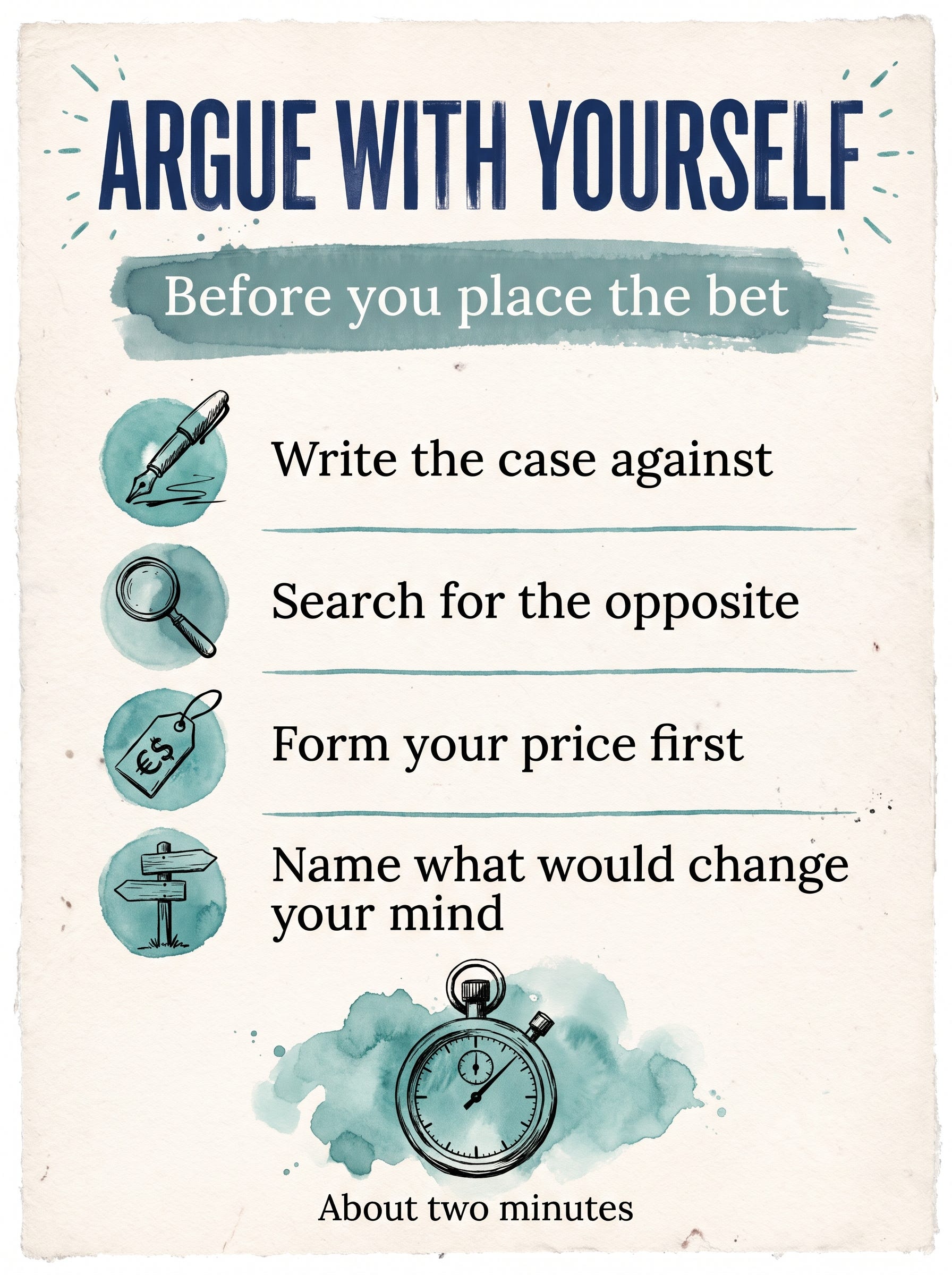
Write the case against. Before you place the bet, write down two real reasons it could lose. If you can’t think of any, you haven’t finished your research.
Search for the opposite. You went looking for why the home side wins. Now spend five minutes looking for why they don’t. Read the person who disagrees with you, especially if they annoy you.
Form your price first. Decide what you think the team’s chance is before you look at the odds. We covered how to do this in the bookmaker post. It’s much harder to talk yourself into a price you have already said is too short.
Name what would change your mind. “If their keeper is out, I’m off this bet.” Pick it in advance, so you can’t explain it away later.
None of this takes long. Most bets need about two minutes of it, and some of them won’t survive those two minutes. That’s the idea.
Your memory is on your side, and that’s the problem
There’s one more trap, and it comes after the result.
Ask most bettors why they backed a team three weeks ago and they’ll give you a tidy answer. It’s usually a version of events that has been edited since the final whistle. You remember the reasons that turned out right and quietly lose the ones that didn’t.
That’s why the reason needs writing down when you place the bet, in your words, before you know how it ended.
Do that for a couple of months and you get something very uncomfortable and very useful. You can read what you actually thought. You might find that “they’re due a win” comes up a lot, and doesn’t make you any money.
🎯 The Bottom Line
Feeling sure tells you very little about whether you’re right. In Slovic’s study, certainty kept climbing while accuracy stayed put.
Good research should be able to change your mind. If yours never has, it’s worth asking what it’s really doing.
Next time you’ve got a strong feeling about a bet, give the other side two minutes before you give it your money.
Bet Journal lets you add a note to every bet, so your reasoning is there in your own words when you come back to review it.
💬 When was the last time your research talked you out of a bet?